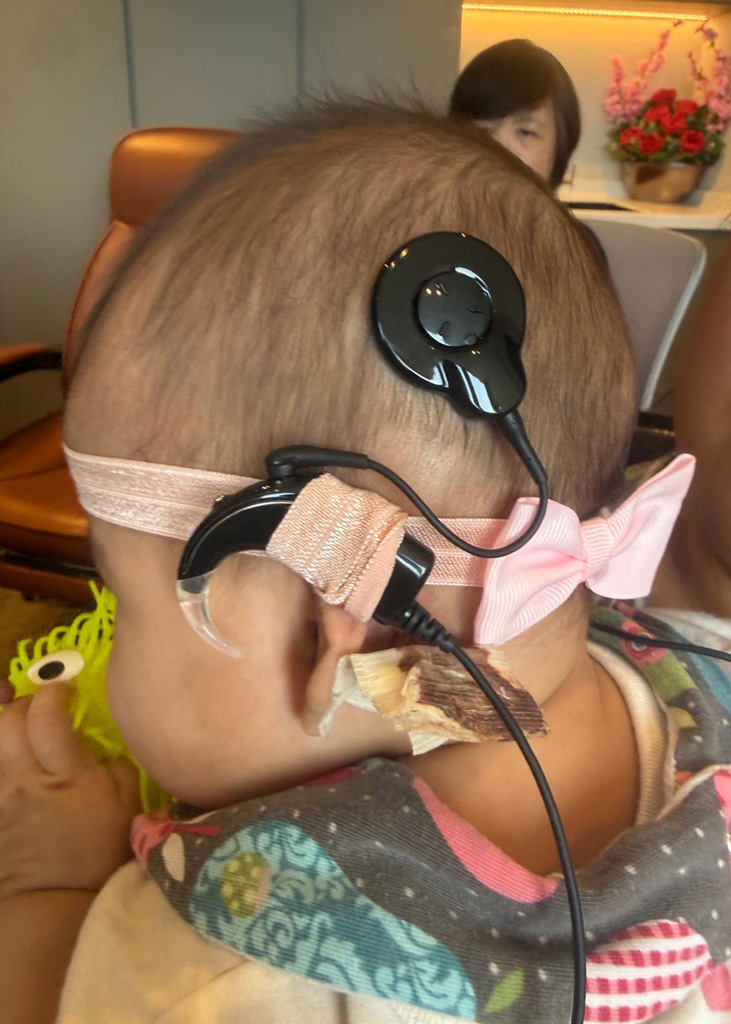
In January 2026, my team and I fitted the youngest cochlear implant patient in Singapore. She was just six months old.
This is still rare locally. Most infants at that age do not meet the minimum weight requirements for surgery, and many families only arrive at this decision much later. When we first met her, she was nursing quietly at her mother’s breast. Her mother had a gentle stillness about her — a kind of resilience that comes from already knowing what lies ahead, even if the path is not fully clear.
We spoke about how her baby had never responded to sound and had not met early vocalisation milestones. Her world was small. They rarely went out. Books were rarely read, not because her mother did not want to read to her, but because it felt different when the baby could not hear her voice.
Her mother shared something that stayed with me. With hearing aids on and with her mother’s soothing presence, the baby was able to fall asleep more easily — almost as if the gentle vibrations, rather than sound itself, reassured her that her mother was near.
Clinically, I felt a sense of urgency. But at the end of the day, the decision is never mine to make.
As audiologists, our role is to provide information, guidance, and perspective. The final choice always belongs to the parents.
We know from decades of research that early cochlear implantation — particularly before the age of one — is strongly associated with better expressive and receptive language outcomes. Children who are implanted early and followed closely by an audiology and therapy team have been shown to achieve age-appropriate language skills by the time they enter school. (Reference: https://pmc.ncbi.nlm.nih.gov/articles/PMC8295935/)
But knowing the evidence is only one part of the work.
Handling these conversations requires great care.
First, many parents are already grappling with difficult, unspoken questions. Some quietly wonder if they did something wrong during pregnancy, or if something they ate or failed to do caused this. Acceptance does not come easily, and guilt — whether acknowledged or not — often sits in the background.
Second, family voices matter more than we sometimes realise. Grandparents may express fears of stigma, of visible devices, of bullying. Comments like “I don’t want my grandchild to be seen wearing hearing aids” can slowly become the parent’s own inner voice. These concerns are not malicious — they are rooted in fear — but they weigh heavily on decision-making.
Third, some parents wrestle deeply with questions of identity. They ask whether they should be embracing the Deaf world instead of pursuing hearing devices. There is a real concern that encouraging hearing aids or cochlear implants may feel like asking a child to reject deafness — and by extension, to reject part of who they are.
I understand why this is such a painful question— both professionally, and as a parent myself.
Hearing loss is permanent. It does not simply disappear. It becomes part of a person’s life story. Some parents therefore wish to delay intervention, hoping to let their child decide later which world they belong to.
The challenge is that speech and language development cannot be postponed without consequence. The brain’s window for acquiring spoken language is time-sensitive, ideally before the age of three. When this window is missed, the impact can be lifelong.
I have worked with adults who were born deaf, did not have access to sound early in life, and were only implanted in their 30s or 40s. Many achieved limited word recognition at best and continued to rely heavily on lip-reading. They often spoke about exhaustion, social strain, and feeling left behind in educational and work environments — not because they lacked intelligence, but because spoken language remained unfamiliar.
These experiences stay with me.
My own view as an audiologist is this: A child can be born deaf and still be deeply loved, whole, and valued exactly as they are. A parent’s responsibility is not to erase deafness, but to offer access — access to sound, to language, to education, and to choice.
Providing hearing aids or cochlear implants early gives a child the opportunity to develop spoken language while their brain is ready to learn it. It does not prevent them from later embracing Deaf culture or identity if they choose to do so. What it does is keep doors open.
Parents also deserve support in navigating stigma and curiosity from others. Children can be taught — gently and confidently — how to respond to questions, how to own their devices, and how to understand their own story without shame.
If, one day, that child grows up and decides that the hearing world is not where they feel they belong, that decision will truly be theirs to make. But without early access to sound and language, that choice may never fully exist.
Chermaine Teo
Clinical audiologist
Author’s note
I write this reflection as both a clinical audiologist and a mother. My professional work centres on supporting infants and children with hearing loss and guiding families through complex, time-sensitive decisions. I also recognise that deafness is not only a medical condition, but an identity and a culture for many. This piece is not intended to diminish Deaf culture or lived Deaf experiences. Rather, it reflects my belief that early access to sound and language can expand — not restrict — a child’s future choices. Every family’s journey is unique, and all decisions deserve care, respect, and compassion.