From Communities to Classrooms: Hearing Care for All Children
On 3 March 2026, the International Society of Audiology marks World Hearing Day with the theme, “From communities to classrooms: hearing care for all children.”
Most parents assume hearing care begins and ends with newborn screening at the hospital. Once a baby passes his hearing test, that chapter feels closed.
But in clinic, we often meet children years later — preschoolers, primary school students — who can hear perfectly well yet are quietly struggling in school.
Audiologists hear this sentence often:
“My child passed his hearing test. So his ears are fine.”
And usually, that part is true.
The ears may be fine.
But listening is more than hearing.
Audiologist Angela Loucks Alexander describes Auditory Processing Disorder (APD) as a software issue rather than a hardware problem. The ears — the hardware — detect sound normally. The brain — the software — has difficulty organising, filtering, and interpreting what is heard.
It is estimated that around six percent of the population may have APD. Because routine hearing tests are often normal, these children are easily overlooked.
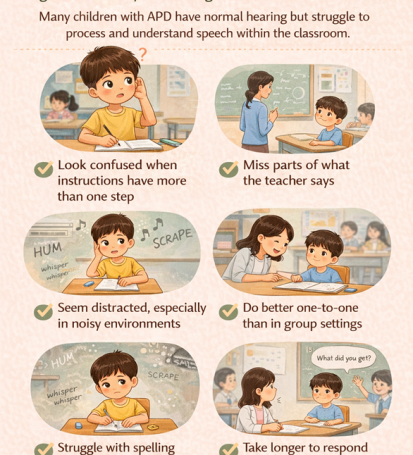
In school, the signs are subtle at first. A child who frequently says “What?” A child who seems lost when instructions have more than one step. A child who mixes up similar sounds in spelling. A child who appears distracted during group work yet performs much better when spoken to one-on-one.
Classrooms are not quiet places. There is the hum of air-conditioning, the scrape of chairs, classmates whispering, papers shuffling. For most children, the brain filters this automatically. For a child with listening vulnerabilities, that filtering system is less efficient. The teacher’s voice competes with everything else.
By the end of the day, these children are often exhausted.
Not because they were not paying attention.
But because they were working much harder than everyone realised.
Auditory Processing Disorder is not about hearing soft sounds. It is about how the brain processes sound once it arrives. A child with APD may hear well in a quiet clinic room but struggle to separate speech from background noise. Verbal information may take longer to process. Similar-sounding words may blur together.
The reassuring part is that APD is treatable. With targeted auditory training and appropriate support, children can strengthen listening skills, auditory memory, and sound discrimination. Assessment can be done from about four years old, which is particularly important in the early years of reading and spelling development. Early identification prevents years of unnecessary frustration — for both the child and the family.
Support does not automatically mean hearing aids. Sometimes it is as simple as seating a child closer to the teacher, reducing background noise where possible, giving clearer face-to-face instructions, or using remote microphone technology. Small environmental adjustments can change a child’s experience of school quite significantly.
Hearing care does not stop at the ear. It extends into the classroom, into learning, into confidence.
If a child is struggling to listen — even with “normal hearing” — it may be worth looking a little deeper.